Steven Carroll
AI core developer, forensic investigator and applied-legal-epistemology researcher — building the instruments that hold legacy legal and financial systems to account, at the bleeding edge of legal and financial technology.
Profile
Three disciplines that rarely meet in one practitioner
Steven Carroll works at the intersection of hands-on AI systems engineering, forensic investigation of professional negligence and malpractice, and peer-grade academic research into the structural blind spots of legacy legal and financial systems. His through-line is consistent across four decades of building: find a systemic blind spot, model it from first principles, and ship the instrument that exposes or corrects it.
He is the architect of the KYC.co platform — an AI-native operating system for regulated commerce spanning AI contract management, escrow, dispute resolution and the CBLT obligation token — and of its computational decision engines. Each engine is an academic paper rendered into working software: the Expertise Check (semantic delegation distance), Network Proximity (Erdős-equivalent impartiality), the Dispute Engine (predictive value escalation) and the Bad Faith Check.
His work sits on the border edge of payments, alternative dispute resolution, provenance and token innovation — applying frontier AI to legal reform, blindspot detection, and the design of trust infrastructure that traditional courts and emerging CBDC architectures were never built to provide.
AI Development
Architect of the KYC.co AI platform and its decision engines — turning research methods into production software.
Forensic Investigation
Network, docket and structural analysis exposing professional negligence, malpractice and manufactured bad faith.
Applied Research
Peer-grade papers (SSRN #6996898) on impartiality, competence and bad faith — received by the CEJ.
Institutional reception
The paper Network Proximity and Expert Impartiality was received by the Centro de Estudos Judiciários (CEJ) — the institution responsible for the professional training of judges in Portugal — entered into the permanent collection of the Biblioteca Armando Leandro, and distributed to its teaching faculty.
The research is available on SSRN under author reference #6996898.
Applied research — network proximity & expert impartiality
From link-network forensics to judicial impartiality
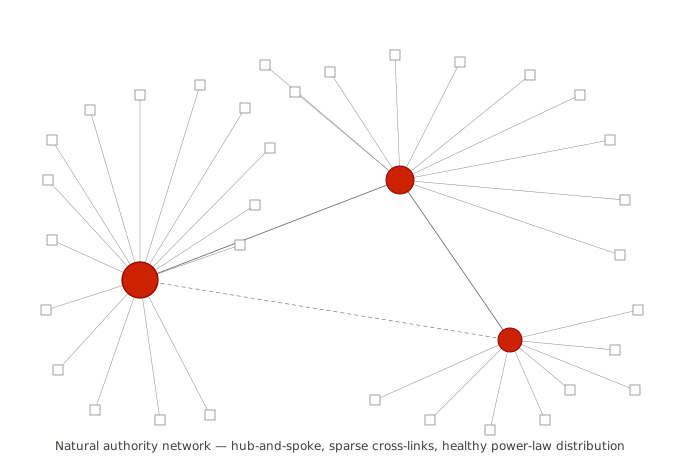
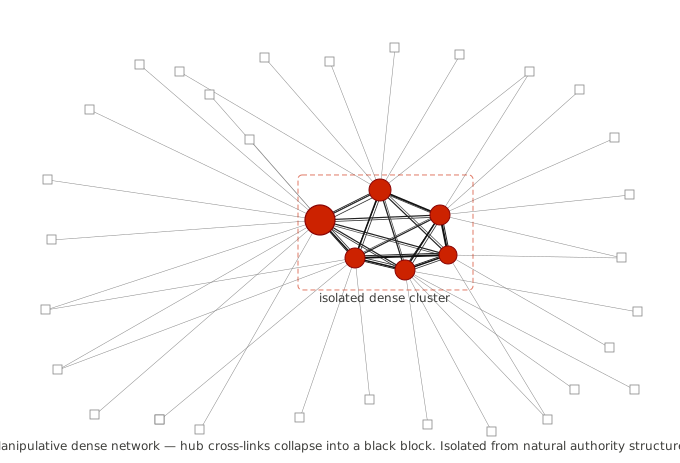
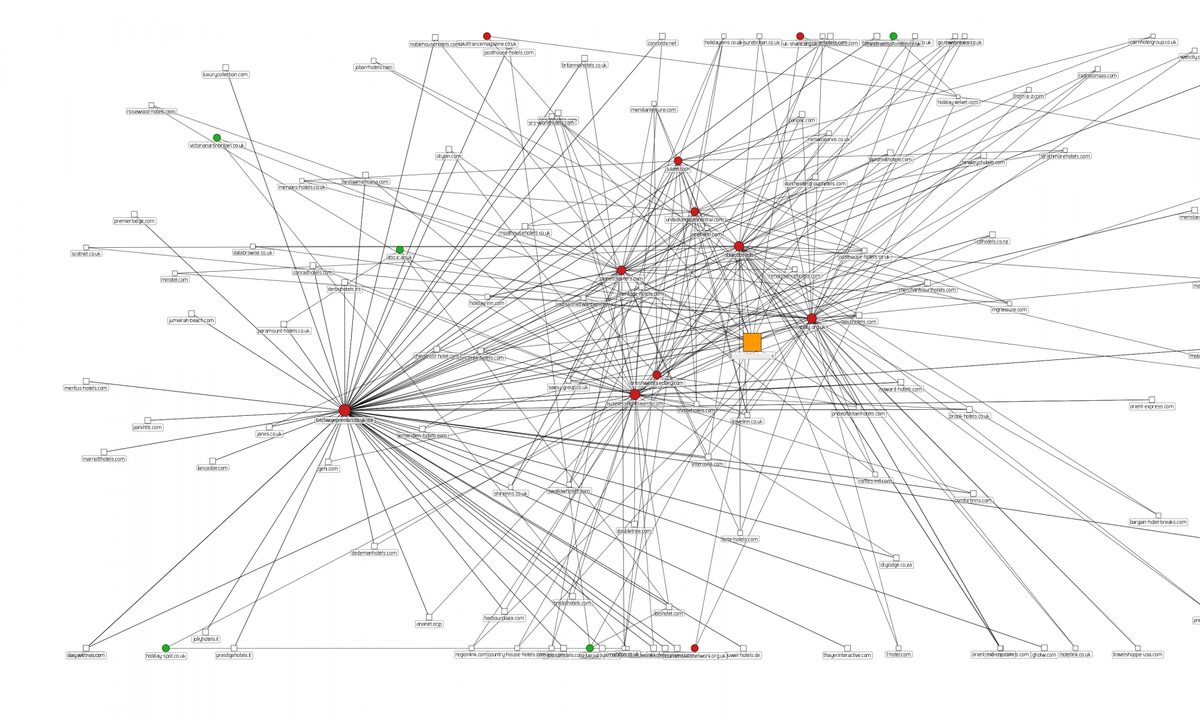
The methodology in Carroll's published research grew out of applied network-analysis work at LinkAudit.co, where he used bipartite-graph modelling to map coordinated manipulation in link-authority networks, framed around Google's Penguin 4 algorithm. The same structural approach — measuring proximity between nodes in a bipartite graph — is what the paper applies to expert-witness appointment networks in civil proceedings, and what now runs inside the Network Proximity engine.
The published research, Network Proximity and Expert Impartiality, documents how the current procedural architecture creates systematic impartiality risks that go undetected by existing recusal mechanisms.
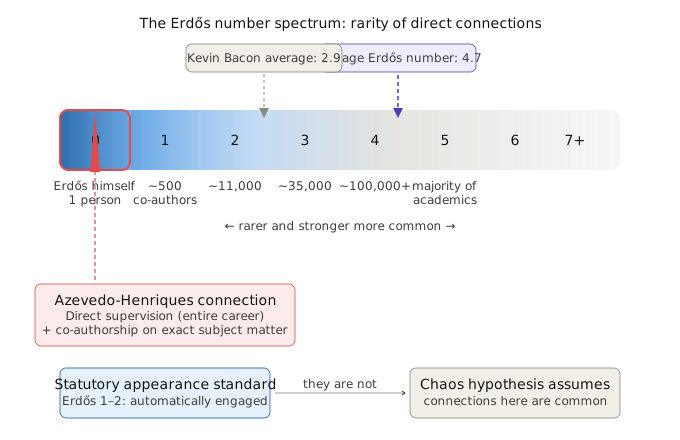
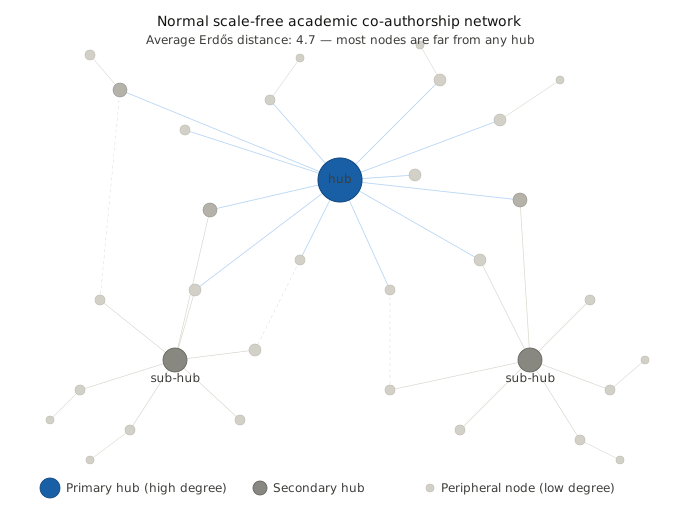
The argument is methodological: academic co-authorship and supervisory relationships can be mapped as a network, and proximity within that network — measured using an Erdős-number framework — provides a rigorous, quantitative basis for assessing whether an expert witness is genuinely independent. Applied to the Azevedo-Henriques case study, the analysis places the expert at Erdős distance 1 from the commissioning party: a level of proximity that is statistically extremely rare, automatically within the statutory appearance standard for recusal — and one that went unchallenged under existing procedure.
Read the paper summary
Expert witnesses in civil proceedings are legally required to be independent. The current recusal mechanism relies on self-declaration and adversarial challenge — a slow, qualitative process with no quantitative standard for assessing network proximity between an expert and the parties they serve.
This paper applies network proximity analysis — using Erdős-number methodology on academic co-authorship and supervisory graphs — to demonstrate that the existing procedural standard is structurally inadequate. In the case study examined, the Azevedo-Henriques relationship places the expert witness at Erdős distance 1 from the commissioning party: a level of proximity that is statistically extremely rare, indistinguishable from direct collaboration, automatically within the statutory appearance standard for recusal.
The paper documents how this proximity went unchallenged under existing procedure, traces the genealogy of the recusal standard through European civil procedure doctrine, and proposes a formal network proximity threshold — grounded in scale-free network statistics — as a required component of expert appointment procedure across European civil proceedings.
Carroll welcomes correspondence from academics, comparative procedure scholars, and judicial education bodies.
Download full paper (PDF) ↗LinkAudit — the methodological origin
Inventive lineage — a first-principles builder
Four decades of building the instrument nobody else had
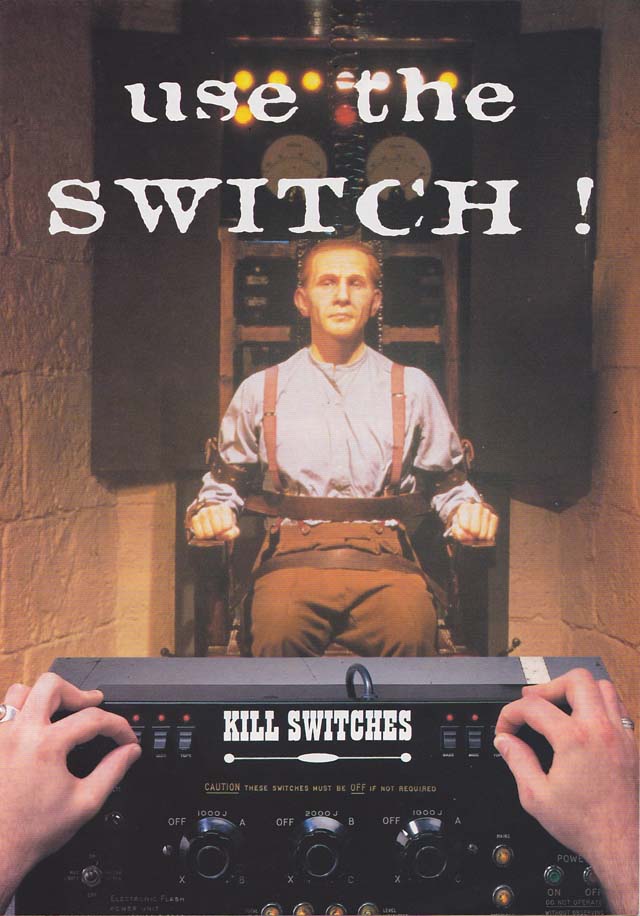
The same instinct that now drives Carroll's AI research — identify a blind spot, model it, build the instrument — produced hardware innovations decades earlier. He began working with electronics at age 10 and founded Intimidation Ltd at 21, under the mentorship of electronics engineer Bill Kelsey. The company designed and manufactured professional DJ mixers between the early 1990s and 2001, most notably the Apex — a compact battle-style mixer that introduced kill switches to the market: the ability to independently drop individual frequency ranges from a live mix, alongside VCA crossfader technology that eliminated the popping artefacts that plagued competing products.
In January 1998, Carroll filed a patent application for a system using encoded vinyl to control digital music. The technology is now known as the Digital Vinyl System (DVS): the method by which professional DJs control digital audio through analogue turntables. The priority claim is disputed; the supporting materials — including contemporaneous correspondence and the original patent application — are archived in full.
Intimidation Ltd — product archive (1993–2001)
Four mixer designs produced under the Intimidation Ltd label. Each introduced features now standard across professional DJ hardware: kill switches, VCA crossfader circuitry, battle-format ergonomics. The Blue became the most widely distributed; the Apex the most technically refined — units from the original production run remain in working use twenty years later.





In January 1998, Carroll filed a patent application for a system using encoded vinyl to control digital audio. The technology — now known as DVS — is the standard method by which professional DJs control digital music through analogue turntables worldwide. Supporting materials, including contemporaneous correspondence and the original patent application, are preserved on the Wayback Machine (all archived snapshots).
KYC.co — the AI platform
Building the missing dispute-resolution infrastructure
Carroll's principal venture is KYC.co — an AI-native, contract-backed alternative dispute resolution platform designed to address a gap that neither traditional courts nor the emerging CBDC architecture has been built to fill.
CBDC infrastructure, as currently specified by the Bank for International Settlements, has been engineered to close the compliance distance between issuing institutions and their endpoints — enabling granular enforcement, direct tax collection, and behavioural incentive structures embedded at the transaction layer. What it has not built — by design — is any mechanism for dispute resolution at that same layer.
As velocity and volume grow under CBDC infrastructure, endpoint disputes will grow exponentially, and the traditional court system has no structural ability to absorb that load. KYC.co is built for this gap: AI-assisted contract creation with expert adduction at the contract layer, resolution through structured ADR, escrow and project management, backed by CBLT — its own obligation token — as an alternative to CBDC settlement rails that lack dispute infrastructure.
Moral.Money — the research & training layer
The second venture is Moral.Money — the venue that hosts the project's academic and training work, including the paper collection and a game-theoretic procedural-reasoning engine that makes questions of expert neutrality, burden of proof, and network structure legible through interactive narrative. Where KYC.co provides the AI software and decision engines, Moral.Money provides the academic writing, training material, and cultural context.